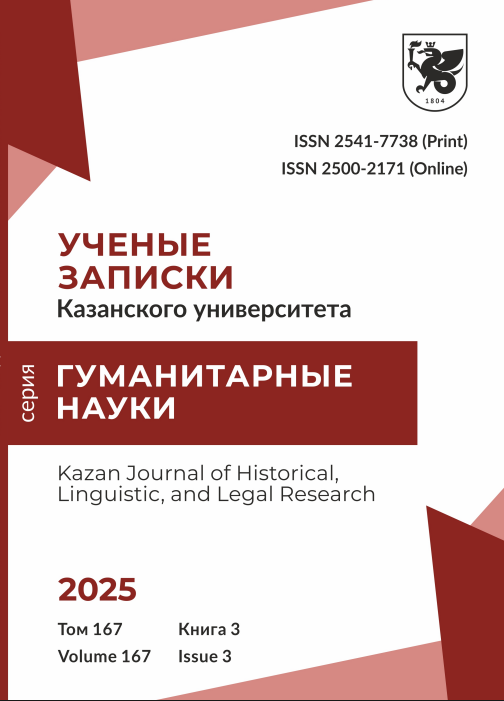
The peer-reviewed scientific journal Uchenye Zapiski Kazanskogo Universiteta. Seriya Gumanitarnye Nauki (Kazan Journal of Historical, Linguistic, and Legal Research) is an official periodical of the Kazan Federal University published in accordance with the Federal Laws on Mass Media.
The Founder and Publisher of the journal is the Federal State Autonomous Educational Institution of Higher Education " Kazan (Volga Region) Federal University", a co-founder of the Association of Science Editors and Publishers (ASEP).
The journal is registered with the Federal Service for Supervision of Communications, Information Technologies and Mass Media (Registration Certificate PI No. FS77-41876 dated August 27, 2010) and the International Centre for the Registration of World Periodicals (ISSN 2541-7738 (print version), ISSN 2500-2171 (electronic version)).
Free price.
The journal publishes original and review articles addressing particular or cross-disciplinary aspects of linguistics, history, and jurisprudence.
The journal is published in print format with a periodicity of 6 issues a year.
Languages of publication: Russian, English.
All manuscripts submitted for publication should be arranged according to the Author Guidelines developed by the Editorial Board.
The journal is covered in CEEOL, CNKI, Dimensions, DOAJ, EBSCO, ERIH PLUS, Lens.Org, Library of Congress, MIT Libraries, OpenAlex, Open Policy Finder (Jisc), Research4Life, ROAD, Scilit, SOLO, The Royal Library, Ulrich's Periodicals Directory, Unpaywall, Wikidata, WorldCat.
Articles published in the journal are also indexed by Google Scholar.
Uchenye Zapiski Kazanskogo Universiteta. Seriya Gumanitarnye Nauki is an open access journal: all articles are freely available without charge for every person/institution to legally read, download, copy, distribute, link, and use in accordance with the Budapest Open Access Initiative (BOAI) and Creative Common License (CC BY).
We provide immediate (without embargo) open access to all full-text articles that have been peer-reviewed and published in our journal. Open access does not apply to either submitted (before peer review) or accepted (peer-reviewed but unpublished) articles.
For full versions of articles published in the journal see our website, Russian Scientific Electronic Library eLIBRARY.RU, and Cyberleninka Library.
Current issue
HISTORY
This article is part of the grant-funded project “Historians of the wartime generation and their dissertations (1941–1945): Collective biography, motivations for scholarly work, and features of dissertation narrative.” It discusses E.N. Sedova’s dissertation, written during World War II and defended at Kazan University on April 27, 1942, based on the investigation of the original copy from the Nikolai Lobachevsky Scientific Library of Kazan Federal University. An analytical overview of the dissertation’s structure, objectives, key findings, and conclusions is carried out. Using a detailed analysis of its content, methods, general principles used by the author for selecting historical sources, the author’s perspective on the events under study, and the chronological context in which the text was created, the major focus and scholarly significance of E.N. Sedova’s research work are identified. From the results obtained, a conclusion can be inferred that, despite the wartime challenges, E.N. Sedova was committed to upholding high academic standards. She was sympathetic to the Russian peasants and the hardships they faced during the reform era, as opposed to the landowning classes and Russian bureaucrats. The dissertation includes critical assessments of pre-revolutionary scholars and follows the principles of the Marxist-Leninist methodology. In modern studies on the history of agriculture and peasant movements, E.N. Sedova is mentioned extremely rarely. Her full name, dates of life, and personal details remain unknown. As a result, both the dissertation and its author have fallen into a sort of historiographical oblivion.
Based on historical and specialized literature, archival materials, and military administration documents, this article examines the history of the military commissariat in the Votyak (Udmurt) autonomous region, formed on November 4, 1920, up to 1925, when the Soviet state launched a military reform. The results of the analysis show that its structure and responsibilities changed with the development of the Soviet armed forces and broader administrative reforms. Particular emphasis is placed on the economic, logistical, and organizational conditions that influenced its work. The contribution of G.A. Lenkov, one of the first military commissars, to the establishment of the system of military authorities in the region is discussed. The findings suggest that the Votyak regional military commissariat played an important role in strengthening the defense capabilities of the Soviet state and supported the effective operation of local military enterprises.
The role of Nikolay Mislavsky, a prominent Russian physiologist, as the dean of the Medical Faculty at Kazan University, which was a special time in his career, is explored. Based on unpublished archival materials, the range of issues that he addressed during the First World War and the Russian Civil War is outlined. The influence of his administrative and leadership decisions on the organization of student life is demonstrated. Using historical analysis, his interactions with both students, whose political awareness was sharpening, and faculty members, whose social and political views were also rapidly evolving, are described. The factors that, despite the growing student unrest, enabled N. Mislavsky to successfully maintain the faculty’s work at the levels of routine administrative matters and large projects are identified. The regulations and administrative measures introduced in response to major shifts in the political life of Russia and its higher medical education are analyzed.
This article describes the main stages in the development of the historical image of I.Ya. Yakovlev (1848–1930), a prominent figure who promoted the pursuit of education among the Chuvash people, covering the period from the second half of the 19th century to the first quarter of the 21st century. Some of the major trends that reshaped the historical memory of him are outlined. The key ways, along with the ideas underlying them, in which he was commemorated at each stage are identified. The major facts and conditions that influenced the formation and representation of his image are examined. Previously unpublished archival materials adding considerably to the current knowledge about him are introduced. Based on the theory of memorial turn and the analysis of commemorative practices, various perspectives on I.Ya. Yakovlev and his legacy are explored. The results of the study suggest that the “memorial turn” in Russian humanities requires more attention to the formation of historical memory and its dependence on different commemorative practices.
In this article, the way the New Poor Law of 1834 became a tool for shaping the social image of the Victorian poor is investigated. The reasons for its introduction are unveiled, and the factors that made its adoption possible are outlined. Based on the textual analysis of the legislative act and the preceding Poor Law Commissioners’ Report, the emergence and development of a stigmatizing representation of the Victorian poor is traced. The influence of this deliberately created image on Britain’s social policy towards the lower classes is demonstrated. The philosophical doctrines of Malthusianism and Benthamism that were put forward by the architects of the reform are discussed. The theoretical propositions that ideologically justified the new system are identified. It is concluded that the resulting social image, intended to discredit the poor, served as a legitimation for the abolition of the social relief system and the establishment of a new social order.
This article presents a historiographical study of the earliest museum proposals for preserving and exhibiting the Turkic-Tatar cultural heritage that were developed by Kazan professors B.F. Adler and A.M. Mironov in the 1920s. Using a comparative analysis, their key elements are identified: the museum’s name, the institutional model, the organizational structure, staffing, the sources for collection growth, and the location within the city. To better understand the history of the Kazan projects, they are examined in the broader context of similar initiatives on preserving the Tatar heritage in Ufa and Crimea. The main advantage of B.F. Adler and A.M. Mironov’s projects was their vision of the museum as a place for interpreting history and culture rather than simply displaying artifacts. They wanted to show that the Turkic-Tatar heritage is an integral part of Russian culture and opposed “museum chauvinism” fueling cultural conflicts. The concepts introduced by B.F. Adler and A.M. Mironov are still relevant and can be used as a theoretical platform for creating the Museum of the Tatars. The projects of such a museum can be considered an early stage in the emergence of the theory of museum orientalism in Soviet Russia as a new direction in museology.
LINGUISTICS
The digital revolution of the late 20th and early 21st centuries has fundamentally reshaped the field of literature. This article examines how world and Russian-language fiction has changed between 1980 and 2024 to adapt, using the mechanism of remediation, to the conditions of digital reality. The analysis traces the evolution of narrative structures from hypertext experiments to imitations of chats and news feeds, as well as the transformation of the literary character from the romanticized cyberpunk hacker to the depressed “digital nomad” and the post-human with an “external soul” stored in a smartphone. Particular attention is paid to linguistic mutations and specific narrative tactics, including the incorporation of Netspeak (abbreviations, lowercase writing without punctuation), the use of emojis as illocutionary markers and syntactic substitutions, and visual syntax (such as line breaks that mimic message delivery in instant messaging). The findings show that the hybridization of spoken and written language has modified the rhythmic and syntactic organization of literary texts, as illustrated by the examples from contemporary novels, and suggest that literature, by mastering the logic of digital media, retains its key anthropological function, which consists in searching for what makes us human and for the meaning of life behind the mask of the avatar.
This article explores the characteristics distinctive to fixed expressions used in the Nigerian English media discourse. The general extent to which traditional British and American English fixed expressions are transformed under the conditions of media bilingualism in Nigerian English was determined. Using a comparative analysis, the most and least common types of grammatical and lexico-semantic transformations were established. Inverted word order and the omission of articles and prepositions were identified as the most typical grammatical transformations. Lexical substitution and noticeable shifts in meaning compared with standard English usage were found to be the most frequent lexico-semantic transformations. The results show that Nigerian English media often incorporate fixed expressions from autochthonous languages in order to better describe the local lifestyle. The conclusion reached is that the grammatical and lexicosemantic adaptation of fixed expressions in the Nigerian English media discourse is driven by the need to follow Nigerian cultural norms and by the interference of indigenous Nigerian languages.
Qualitative and quantitative aspects of the interaction between adverbs and prepositional case forms capable of expressing the same or closely related meanings remain underexplored. This article presents a statistical description of the correlation between adverbs of manner ending in -o/-e and “с + instrumental noun” forms (such as важно – с важностью), which are their potential grammatical synonyms. The data from the four-volume Dictionary of the Russian Language and the Russian National Corpus were analyzed by corpus-based, transformational, and statistical methods. Using an “adverb-centered” approach, three types of correlations between adverbs and corresponding prepositional case forms were identified: zero (40 % of the adverbs analyzed), weak (34 %), and strong (26 %). The structural, lexical-semantic, and semantic-grammatical causes underlying the lacunarity of correlates were revealed, and their functional roles were demonstrated. The distribution of morphologized and non-morphologized adverbials of manner was quantified, and the limits of their grammatical synonymy were found. The obtained results expand our understanding of the semantic potential of adverbs in expressing the manner of an action and contribute to future studies on the productivity of competing morphosyntactic models and grammatical lacunas in the Russian language.
Based on the analysis of semantic parameters that can be quantified, this article examines the system of memorial urbanonyms in the Kaliningrad region, which developed as a result of the large-scale renaming in the aftermath of World War II, and compares it with an average model of memorial urbanonymy in the Central Federal District of Russia, derived using the methods of linguistic statistics. The results indicate that the two naming systems are generally similar to each other. Particularly, they show comparable numbers of dedications to politicians, writers, and events from the country’s pre-Soviet history. In the Kaliningrad region, the street names honoring artists, especially composers, prevail, whereas the dedications to local residents are extremely rare.
This article explores how censorship on English-language digital platforms influences the linguistic behavior of their users. The analysis, based on the user-generated content published on YouTube, Reddit, and TikTok between January and May 2025, revealed that strict moderation rules enforced by the digital platforms and the possibility of legal punishment from government significantly alter the ways in which users express themselves online in an effort to resist censorship pressure, leading to the development of various forms of netspeak, such as algospeak employing intentional linguistic obfuscation aimed at minimizing the risk of account blocking and other negative outcomes. Different linguistic masking strategies that enable users of the digital platforms to communicate were identified. The specific semantic and graphical techniques to bypass content moderation, including euphemization, neologism creation, semantic shifts, use of acronyms, and graphical modifications, were described and systematized. From the obtained results, a conclusion was drawn that euphemisms and neologisms have become the main linguistic tools of resistance and adaptation in a censored digital environment.
JURISPRUDENCE
Digital sovereignty refers to the ability of a state to independently determine the parameters of regulation of its digital space and related infrastructure. The issues surrounding digital sovereignty have been the subject of extensive discussion from scholars across a wide diversity of disciplines. This article presents the results of a study on Russia’s steps to strengthen its digital sovereignty and threats to its national values in different public areas (economic, social, political, and spiritual) that may be associated with them. The obtained results show that such threats are inseparable from the protection of the core constitutional values and can lead to the general crisis of confidence at the subject–object and subject–subject levels.
This article examines the organization of sports dispute resolution in the Court of Arbitration for Sport (CAS) and emphasizes that its mechanisms should be based on specific rules and procedures governing sports and recognize the authority of competition officials to make decisions during and after competitions. The CAS primarily functions as an adjudicatory tribunal with the power to not only “review” disputes, but also to “decide” them by issuing final and binding awards that apply common legal standards to particular cases in order to determine, modify, and (or) terminate the rights and obligations of the parties involved. The analysis of the history of the sports disputes resolved by the CAS shows that it promotes mediation as a preferred practice to settle disagreements. Because conflicts in sports emerge typically due to the intense emotions and psychological pressures that accompany sports events, the above approach seems to be justified. CAS mediators are qualified to “de-escalate” the emotional tension by helping the parties focus on objective facts. The development of alternative methods for resolving disputes with the creation of specialized “jurisdictional bodies” and “disciplinary committees” represents a good trend to improve the efficiency and accessibility of justice in sports.
This article examines most-favored-nation (MFN) treatment in investment treaties with special attention to the limits of its application in the contemporary arbitral practice. By tracing the evolution of different approaches to interpreting MFN clauses, the reasons behind the departure from expansive readings of MFN by investment tribunals were explained. Particular emphasis was placed on the distinction between substantive investment protection standards and procedural arrangements for dispute settlement, as well as on the operation of the ejusdem generis principle. Based on the analysis of recent international investment arbitration decisions and new treaty models, it was demonstrated that MFN treatment is no longer perceived as a universal tool for extending investor protection. The conclusion was therefore drawn that international investment law is adopting a more cautious and formalistic approach centered on treaty language, state consent, and legal certainty.
This article presents the findings of a comparative study of tokenized stocks and traditional initial public offerings (IPOs) from the perspective of the legal protection of investor rights. The analysis is based on the functional classification of tokenization models in business (registry-based, custodial, and synthetic), which provides the foundation for comparing the scope of corporate and legally binding investor rights with applicable regulatory regimes. Using the international standards (BIS, FSB, IOSCO), EU regulations (ESMA, DLT Pilot Regime, MiCA/MiCAR), and Russian legislation on digital financial assets (DFA), the mechanisms of prospectus control, listing, custodial protection, secondary trading, and dispute resolution governing both systems were systemically assessed. The results show the configurations in which tokenization reproduces or strengthens traditional guarantees, as well as those that give rise to “regulatory gaps” and opportunities for regulatory arbitrage. Targeted proposals for reforming the current EU and Russian regulatory frameworks based on the principle of regulatory equivalence were outlined.

ISSN 2500-2171 (Online)